
Grinder’s Skinwalker Ranch from Hell #3
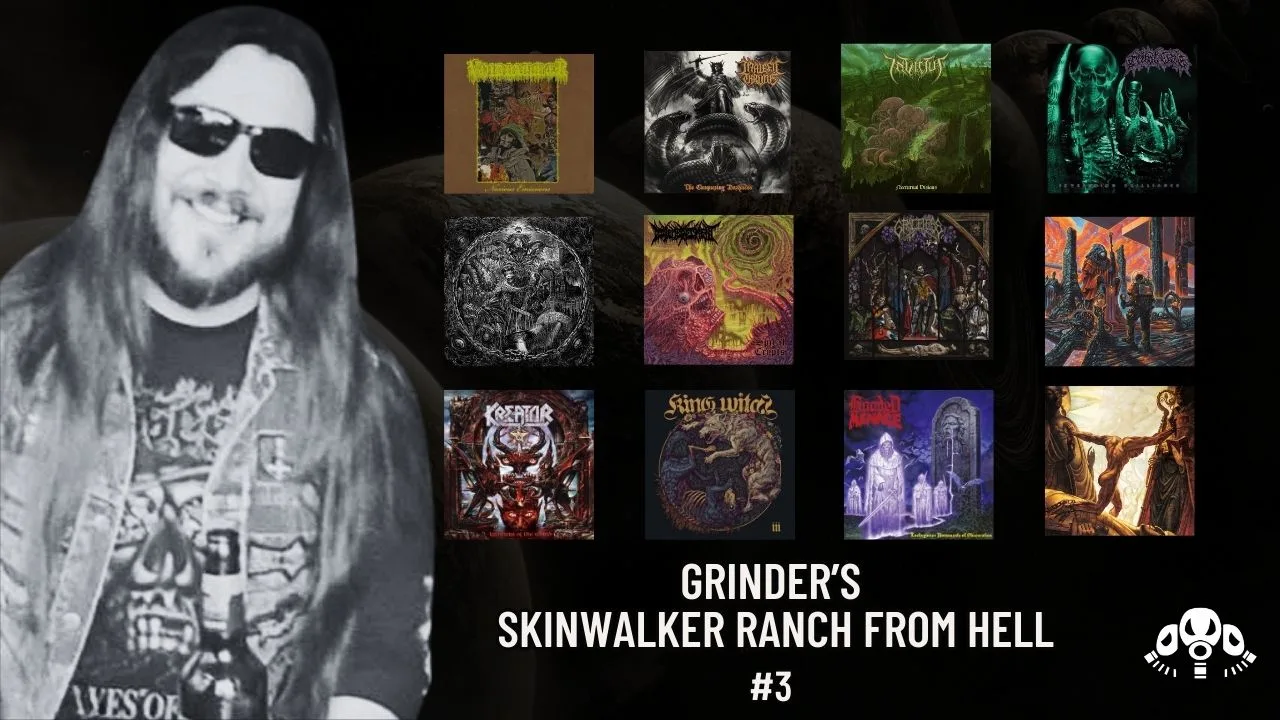

Underground music and its traditions have shifted beyond recognition. What once demanded commitment, patience, and obsession is now filtered through a digital scroll hegemony where everything is reduced to a fleeting image, a thirty-second clip, a disposable reaction. Music is no longer experienced; it is consumed, skipped, and instantly replaced. In this landscape, value collapses. Sound becomes generic, identity becomes algorithmic, and art turns into a temporary digital commodity designed to disappear as fast as it appears.
Grinder’s Skinwalker Ranch exists as a direct refusal of that reality. Here, we treat music as something sacred, dangerous, and alive—something that demands time, attention, and belief. This column operates in an alternative dimension, far from metrics, trends, and content logic. It is a place where underground music is not background noise but a form of resistance, a continuation of culture rather than a product optimised for speed.
To stand against musical devaluation today is to defend existence itself. Valuing riffs, atmosphere, intent, and tradition is no longer nostalgia—it is survival. In this fractured digital age, the underground must become its own parallel reality, a zone where meaning still matters.
Grinder’s Skinwalker Ranch III continues that mission under the banner of Extreminal Metal Music Magazine: preserving the unseen, amplifying the ignored, and keeping this alternative musical universe alive—against all odds.
Voidhâmmer – Noxious Emmissions (Caligari Rec. 2026)
It’s been a long time since I came across a darkened death metal project with such a strong crust influence, so this genuinely made my day. Voidhämmer sends greetings to all you underground metal maniacs straight from Long Beach, California. They’re still a relatively new band, and this release is their very first EP, out via Caligari Records. The EP is available for digital purchase on Bandcamp, and it also seems to be released as a limited cassette edition of 150 copies, which definitely fits the raw, DIY spirit of this kind of music.
The band consists of three members, but from what I can tell, the drummer appears to be the main permanent force behind this new project. Musically, what we’re getting here is a brutal blend of filthy, shadow-soaked guitars and the kind of riff mentality that immediately brings to mind that Diabolic-style American death metal tonality; sharp, heavy, and violent in structure while constantly colliding with crust-driven riffs and drum textures. This isn’t crust “as a decoration,” but crust as a real backbone.
The overall result is pure American death metal, but it’s decorated — and strengthened by crust-style up-and-down dynamics, chunky breakdown turns, and those dirty rhythmic drops that make the songs hit harder. The vocals sit perfectly on top of it all: dark, guttural growls, deep and rotten, giving the music a sinister edge without killing its momentum. Everything fits together in a very tasteful way, as if the band already knows exactly what kind of atmosphere they want to create.
Whether they realise it or not, Voidhämmer are also channelling a strange but exciting hybrid: it feels like they’re performing a different variation of ’80s British death metal, filtered through an American death metal lens. And in certain moments, you can clearly catch that old Bolt Thrower / War Master spirit — not in a copycat way, but in that familiar sense of war-torn heaviness, crushing mid-paced power, and grim determination.
This EP is short, sharp, and effective — exactly the kind of first strike that makes a band stand out and proudly announce itself. If you’re into underground death metal, black metal, crust, or grindcore, you should definitely show this band some love and keep an eye on what they do next.
Omegavortex – Diabolic Messiah of the New World Order (Third Eye Temple,2026)
There are bands who “evolve” by polishing their sound, sanding the edges, and slowly turning into a safer, more digestible version of themselves. Omegavortex do the opposite. They mutate like a disease.
With Diabolic Messiah of the New World Order (released via Third Eye Temple in late 2025), the band are not trying to sound big, clean, modern, or fashionable. This record sounds like it was designed to rupture speakers and leave the listener with that familiar underground aftertaste: nausea, adrenaline, and satisfaction.
The album moves in short strikes—eight tracks, mostly in the 2–3 minute range—no filler, no “build-up”, no mercy. From the opening assault of “Dystopian Worldrape” to the blunt execution methods of “Limitless Violence” and “Feeding Upon Blackness,” this is war metal logic applied with a scalpel dipped in filth.
Now here’s where it gets interesting for those who have been following them: compared to Black Abomination Spawn (2020), this album feels like Omegavortex has aggressively leaned into a more bestial black/death framework, pushing the songwriting away from the earlier death metal backbone. The previous full-length was already vicious, but this one is more chaotic in spirit, almost like the band absorbed a punk–grind–noise attitude into their bloodstream. The music doesn’t just attack—it spits, it kicks, it laughs while doing it.
That doesn’t mean Diabolic Messiah… is “radical for the sake of radical.” It’s simply different. More unhinged. Less controlled. And in that shift, you can clearly feel them shedding the Diabolic Sense-era discipline and stepping into something more violently their own.
Titles like “Psychopathic Majesty” and “Whirlwinds of Directed Sadism” aren’t just edgy decoration—they reflect the album’s core personality: an ugly, deliberate, suffocating domination.
No hype needed. No trendy slogans. Diabolic Messiah of the New World Order is the sound of Omegavortex carving a new identity with blunt instruments—and yes, even if the change isn’t total reinvention, the message is clear:
This band now has a new sound, and it’s nastier than ever.
Malefic Throne – The Conquering Darkness(Agonia,2026)
The Conquering Darkness is one of those rare death metal albums where everything clicks with frightening precision. From the first riff to the final decay, Malefic Throne deliver killer songwriting driven by constantly shifting song traffic that never loses its grip. The riffs are savage yet controlled, and Gene Palubicki’s guitar work stands apart from his other projects—there’s a different character here, more deliberate, more venomous, and fully locked into the band’s identity rather than recycling familiar patterns.
Steve Tucker sounds absolutely feral on this record. His vocals carry a sick, commanding presence that clearly separates this performance from his work with Morbid Angel or other past recordings. There’s a darker, more personal edge to his delivery, perfectly matched to the album’s oppressive atmosphere. John Longstreth’s drumming is pure fire throughout—relentless, surgical, and explosive, yet always serving the songs instead of overwhelming them.
What truly elevates The Conquering Darkness is the incredible correlation between the members. Every instrument feels interdependent, every transition purposeful. Each track has its own identity, yet the album flows as a unified statement of American death metal in its most vicious and refined form.
Released in the dying days of 2025, this is easily one of the strongest death metal albums of 2025–2026. If Malefic Throne commits to a full-time lineup and touring, they’re poised to become one of the genre’s most dominant forces.
Ectovoid – In Unreality’s Coffin (Everlasting Spew,2026)
Alabama’s Ectovoid return from the abyss with In Unreality’s Coffin, a full-length that arrives eleven years after their last album—yet it doesn’t sound like a band trying to “catch up.” This is existentially dark American OSDM with a little lethal BM influence, carved from dread, void-minded atmosphere, and riff discipline. The record is soaked in tremolo-driven darkness, but it also leans into slasher-like death metal riffs that feel sharp, predatory, and strangely cinematic. Most songs keep a mid-tempo range, letting the band emphasise groove, weight, and tension rather than cheap speed for the sake of aggression.
The drumming sits right in the pocket: classic OSDM fills, rhythmic patterns, and constant lock-in with the guitars, giving each track a natural forward push. When the leads creep in, they don’t feel decorative—they enhance the old-school spirit and feed the dynamics of each song without breaking the flow.
The real strength here is consistency: there isn’t a single weak section or “why is this here?” moment. If you worship Incantation and Drawn and Quartered, and you haven’t been aware of this band and album, it won’t take you more than two minutes to fall into this coffin willingly.
The Furor – Phenomenal Abomination (Independent,2026)
Coming out of Perth, Western Australia, The Furor has been operating as a scorched-earth black/death weapon since 2002, and Phenomenal Abomination proves the project is still fueled by the same two obsessions stamped all over their identity: war and Armageddon. This isn’t a band chasing relevance; it’s a long-running underground unit built for destruction.
And you can hear that veteran confidence immediately. A lot of modern black/death either hides behind cinematic atmosphere or goes “technical” just to impress other guitar nerds. The Furor doesn’t do either. This album is direct violence, the kind that smells like burnt cables and cratered ground. The riffing hits like mechanised infantry: tight, grinding, relentless. Songs like “Black Storm of Invincible Mayhem” and “Molten Militia” don’t try to be friendly: they’re written to maim, then march forward.
What makes it even more satisfying is knowing The Furor’s core has often been run like a one-man war machine (Dizazter at the centre), and that singular vision shows: no filler, no trend-hopping, no mercy. Phenomenal Abomination isn’t here to innovate. It’s here to dominate.
Recommended if you worship: early Angelcorpse, Diocletian, bestial-era black/death warfare, and anything that sounds like a battlefield collapsing in real time.
Architectural Genocide – Malignant Cognition (Comatose,2026)
A fairly new band from the Texas Houston death/grind crew, they released their first album in 2020. This 2026 album is a slamming-influenced death/grind release similar to the first one. They blend brutal slamming death metal with old-school American Texas death-grind style, and there is also some old Suffocation influence lurking in the guitarist’s riff work.
Some riffs are truly mind-opening and can feel like you’re going through brain surgery, but sometimes the groove riffs and drum parts remain a bit cynical and don’t hit as hard as they could. The vocals are all guttural force and deep growls, while the lyrics and concept take you into a sci-fi-influenced snuff world dripping with cold violence.
The songs are definitely not long — they perform the surgery quickly, around 2–3 minutes in length, cutting straight to the nerve without wasting time. When they add a bit more speed and combinations, with a sharper mix and recording, they will become a much more killer band. I liked the album — fans of this style should not pass on it, you will enjoy it.
Hazardous – Let There Be Dark (Independent,2025)
Hazardous is a very young band from Istanbul, Turkey, but the confidence and aggression on this release go far beyond their age. Musically, what they deliver can best be described as crossover-influenced splatter thrash metal, yet with a noticeably darker and more extreme edge than most bands operating in that territory. The riffs and drum work often lean toward extreme metal aggression, giving the album a harsher and more hostile character than standard crossover thrash.
The overall sound is clearly above average, especially for an independent release. One of the album’s strongest points is its songwriting discipline: there’s very little filler here. Instead, the record moves with a constantly shifting and energetic song traffic, keeping things dynamic within a thrash metal framework. Every time the band avoids generic riffing and lazy transitions, the material shines even more—and thankfully, that happens often.
Lyrically and on visual artwork, the band fully commits to a splatter and ’80s horror aesthetic, which fits the music perfectly and strengthens the album’s identity. This sense of coherence makes the record feel focused and intentional.
Hazardous is clearly a promising band, and the fact that this album was released independently only adds to its impact. Fans of underground crossover thrash and splatter thrash metal will definitely enjoy this, and labels working in this style would be wise to pay close attention.
Invictus – Nocturnal Visions (2026)
Invictus are a trio from Japan’s Nagano region, completely obsessed with sick riffs and death metal. This second full-length arrives six years after their debut, released as a CD via Memento Mori and on vinyl via Me Saco Un Ojo Records—a perfect match for a band that sounds like it was born in the catacombs.
Everything about Invictus screams death metal. There’s no outside filler, no modern gimmickry, just total commitment to the genre’s purest disease. One of the most striking elements is the bass guitar: compared to many bands, it’s massively dominant in the mix and in the writing, used almost like a rhythm guitar throughout the partitions. That choice gives the album an unbelievably sick sound—dense, physical, and constantly moving beneath the riffs like a second set of jaws.
Every song is rhythmic, harmonic, dynamic, and moody, building an atmosphere that feels both underground and strangely elegant in its darkness. You don’t need time to “warm up” to it—the mood grabs you instantly, and getting inside the flow takes only seconds. The pacing is sharp, the structures are tight, and the momentum never drifts into boredom. Some of the lead riffs are especially well-written and perfectly placed inside the compositions, feeding the darkness without breaking the violent forward motion.
If I had to point to close references, I’d say early Gorguts and Morta Skuld—that same deep-rooted death metal logic, but sharpened into a modern weapon. Death metal maniacs: you have to check this out.
Enshine – Elevation (Independent,2026)
Originally conceived as a one-man project by Swedish musician Jari Lindholm, this band evolved into an international entity with the addition of French vocalist and keyboardist Sebastian Pierre. Together, they reinterpret old-school Scandinavian melodic doom-death metal through a more modern lens, blending classic structures with subtle sci-fi and supernatural elements while exploring deeply existential themes.
The songwriting is rooted in traditional doom-death foundations and rarely strays far from that core, yet the execution feels colder, more clinical, and refined. Dominant melodic lead guitars, atmospheric riffing, and carefully layered keyboard passages shape a sound that reflects European melancholy and emotional isolation. There is a constant sense of winter depression running through the album—slow-burning, introspective, and heavy without relying on excess aggression.
One of the band’s strongest aspects is the balance between melodic and atmospheric guitar work and the haunting keyboard textures, all anchored by fierce, ripping growls that cut through the dense atmosphere. The brutal vocals contrast effectively with the reflective mood, reinforcing the existential tension at the heart of the compositions.
This album is clearly aimed at doom and death metal listeners who enjoy questioning existence while drowning in cold, melancholic soundscapes. Fans of the style—and labels searching for authentic, emotionally driven underground acts—should absolutely keep an eye on this independent release.
Oraculum – Hybris Divina (Invictus Productions,2026)
One of the long-standing acts of the Chilean metal underground, Oraculum return with their third album after roughly sixteen years of activity. The band delivers a form of death metal that is deeply rooted in old-school traditions, drawing heavily from first-wave influences such as Hellhammer, Celtic Frost, and Possessed. At times, the songwriting leans strongly toward early Celtic Frost and raw 80s doom metal, giving the album a distinctly primitive and ritualistic feel.
Occult and supernatural themes run throughout the record, perfectly aligned with the band’s devotion to first-wave aesthetics. These influences are not used as decoration but form the backbone of the compositions, resulting in songs that feel sincere, energetic, and genuinely fun to listen to. The band clearly commits to a cult-oriented sound, and that dedication works in their favour—nothing here feels forced or lame. Instead, the album comes across as a pure expression of the music they love and live by.
That said, the album’s Achilles’ heel lies in the mixing and production. At times, the snare and drum recordings sound underdeveloped, slightly weakening the overall impact. Despite this, fans of old-school, first-wave-influenced death metal with strong doom elements will likely enjoy this album as much as I did.
Frigid(US)– Contempt of Decay E.P.(Iron Fortress,2026)
Hailing from Chicago, Illinois, Frigid are a very new trio, but they already sound fully locked into their identity. After releasing a handful of demos and singles in 2025, the band now steps forward with their debut EP in 2026, and it immediately shows confidence and purpose. What they deliver is a distinctly Chicago-flavoured death metal attack built on razor-sharp, dynamic thrash-slasher death metal riffs.
The band’s core sound is driven by tight, aggressive guitar work that channels old-school American death-thrash rather than leaning heavily into Swedish or European influences. There are only faint traces of Scandinavian tone here; instead, the riffs are sharp, dry, and cutting, supported by fast, punchy thrash-death drumming that keeps the momentum constantly moving. The vocals are another strong point—hostile, aggressive, and shifting between different growl registers, adding urgency but also predictability to the songs.
Frigid’s devotion to old-school thrash-death metal is most clearly defined by their riff writing and guitar tone, both of which feel authentic and rooted in classic US underground traditions. Personally, I really enjoyed the guitar and drum performances throughout the EP. The only real drawback is the bass guitar, which feels buried beneath the guitars and drums. Stronger, more lethal bass lines would have elevated the EP into something even more vicious.
If forced to label them, Frigid sound like a more death-thrash metal-oriented version of their Chicago peers Cianide, mixed with early Incubus (US). Overall, this EP shows real promise and marks Frigid as a band worth following closely.
Disembodiment – Spiral Crypts (Everlasting Spew,2025)
Hailing from Québec, Canada, Disembodiment is a band fully devoted to blood, filth, horror, gore, death, and the true spirit of death metal. Active since 2020, the band released an EP in 2021 and now presents their first full-length album, which has been out for roughly six months. This record clearly marks a major step forward, both in commitment and overall sonic sickness.
Musically, Disembodiment focus heavily on early 1990s death metal songwriting, drawing primarily from American OSDM while also incorporating elements of old European death and death-grind traditions. At times, the album even hints at that raw European death-grind flavour, yet it remains firmly rooted in North American death metal brutality. The compositions are never one-dimensional; instead, they constantly shift and evolve, with every instrument actively contributing to both the songwriting and the overall atmosphere.
Compared to the EP, the album sounds far more obsessed, more diseased, and more complete. The vocals are fit-in and strong, convincing, and dominated by deep American-style growls that fully serve the lyrics. There is no unnecessary technical show-off here; everything is exactly where it should be, raw and effective.
The dynamic songwriting and oppressive mood pull the listener straight into a dark, morbid old-school death metal nightmare. If you need a reference point, think early Repulsion, old Obituary, Broken Hope, Regurgitation, or Rottrevore. For fans of truly sick US OSDM, this album is an absolute hotspot.
Graceless – Icons of Ruin (Listenable Records,2025)
I’m only now getting properly into Graceless’ latest album, a bit late maybe, but some records actually benefit from that delayed listen. Graceless are a Dutch band formed by underground veteran musicians from different countries, most notably members connected to Soulburn, Asphyx, Xenomorph, Nailgun Massacre, and other deep-rooted European death metal acts. That collective experience is felt strongly across this album.
While earlier Graceless releases already showed small shifts and variations, Icons of Ruin takes things further and explores noticeably different directions. Some riff structures lean into a more doomy and atmospheric territory, while others suddenly break into filler thrash riffs that cut sharply through the songs. Compared to previous albums, the band is clearly more adventurous in its musical approach.
At times, you hear old-school, crusty death metal, only to be hit moments later by a sharp, classic thrash solo. On the next track, the mood may shift completely into a darker, slower, doom-infused death metal atmosphere. These transitions never feel forced; instead, they add character and unpredictability to the album.
The songwriting is highly dynamic and genuinely fun, showing a band that wanted to challenge itself without abandoning its identity. Graceless manage to absorb these influences naturally into their own sound. Anyone looking for a thoughtful, European-style death metal album with strong dynamics and variation should not miss this one.
Kreator – Krushers of The World (Nuclear Blast,2026)
I started listening to Kreator’s latest album by consciously setting aside their legendary 1980s and early 1990s records, which I personally worship. If you are also deeply attached to that raw, violent era, I strongly recommend doing the same. Approaching this album through that lens will only lead to frustration. Instead, this record should be heard as a thrash-influenced European heavy metal album, not a continuation of classic Kreator.
Musically, the album leans far more toward European-style heavy and melodic thrash metal than old-school thrash aggression. The production is easily one of the most polished and high-budget metal sounds I’ve heard in the last two to three years. Even in the most aggressive moments that vaguely resemble classic Kreator, everything—from vocals to riff structures—sounds extremely refined and calculated. It feels intentionally designed to appeal not only to thrash fans, but to a much broader rock and metal audience.
The songwriting is dynamic and varied, built around heavy-thrash foundations with melodic, chorus-driven structures. Ventor delivers a solid and professional drum performance, as expected. Vocally, the album relies heavily on anthemic, chorus-focused lines, closer to classic heavy or even power metal traditions than raw thrash shouting.
In summary, if you approach this album not as a Kreator record but as a highly polished, well-funded European heavy/thrash metal release, it works surprisingly well. This is not an album for die-hard thrash or extreme metal purists—but as a modern, high-production metal album, it’s far from bad.
Void Monuments – Posthumous Imprecation(Blood Harvest,2026)
Void Monuments operate firmly within the language of classic death metal, drawing heavily from both early 1990s American and European schools, often blending the two into a unified and convincing whole. Rather than leaning into the colder, more mechanical traits associated with their approach feels closer to the genre’s core traditions.
From the album artwork to the songwriting structures, Posthumous Imprecation openly declares its allegiance to classic death metal. The riffs are sharp, functional, and purpose-driven, favouring direct impact over technical excess. Some riff patterns and song structures tend to repeat themselves, and over the full runtime, certain tracks blur together due to similar tempos, chord choices, and transitions. While this repetition reinforces the album’s old-school character, it can occasionally limit the creativity at guitar work and traffic.
Vocals remain commanding and fit naturally within the mix, while the rhythm section delivers a steady, muscular foundation throughout. There is no attempt to reinvent death metal here—only to preserve and execute it with conviction.
Despite moments of repetitiveness, Posthumous Imprecation stands as a solid and sincere death metal release. It will strongly appeal to listeners seeking pure, traditional death metal, rooted firmly in the early ’90s ethos and delivered with modern clarity and discipline in the sound. You’ll enjoy it.
King Witch – III (Listenable Rec.,2026)
King Witch have sat comfortably at the crossroads of classic doom, heavy metal, and hard rock, but what truly elevates their sound is Laura Donnelly’s vocal performance. Her voice fits the heavy doom framework perfectly—powerful, expressive, and eclectic without ever feeling forced. She moves naturally between haunting melodies and commanding, soulful lines, giving the songs both emotional depth and character.
Instrumentally, the band are equally convincing. The guitars are solid and confidently played, balancing crushing doom riffs with more melodic and classic heavy metal phrasing. There’s a clear sense of purpose in the songwriting: riffs aren’t just stacked for heaviness, but arranged to serve the flow of each track. The transitions between sections are smooth, and the dynamic shifts keep the listener engaged from start to finish.
What stands out most is the riff traffic and overall band chemistry. Every instrument has space to breathe, yet everything works together tightly. Bass and drums lock in well with the guitars, reinforcing both the weight and the groove. King Witch don’t rely on repetition alone; instead, they build songs that evolve organically, making their heavy doom sound rich and deeply satisfying.
Hooded Menace – Lachrymose Monuments of Obscuration(SOM,2026)
On Lachrymose Monuments of Obscuration, Hooded Menace take their unmistakable death-doom core and push it into more progressive, heavy-doom–oriented territory without losing their identity so much. The album is built on the band’s classic slow-burn heaviness, but this time the riff traffic is denser, more dynamic, and noticeably more adventurous. Songs evolve rather than simply crush, revealing a clear step forward in compositional ambition.
Much of this progression comes from Lasse Pyykkö’s songwriting approach. He leans deeper into progressive structures and traditional heavy metal phrasing, yet these elements are absorbed naturally into the band’s doom framework. It’s something Finnish bands often excel at—developing complexity without sounding forced or disconnected from their roots. The result is an album that feels both familiar and surprisingly expansive.
Production-wise, the record is well thought out and confidently executed. The guitars are thick and commanding, the rhythm section supports the shifting structures effectively, and the overall sound enhances the album’s darker, more epic/heavy atmosphere than doomy death metal.
Having followed Hooded Menace since 2007, it’s fair to say this is their most heavy-metal-oriented and progressive release to date. That shift may surprise some long-time fans, but the band still clearly sounds like Hooded Menace—just heavier, less death metal and more forward-thinking than ever.
Ophidian Memory – Seraphim (Iron Fortress,2025)
Ophidian Memory is a one-man, fully independent project from Des Moines, Iowa, carried entirely by multi-instrumentalist Blake Lamoureux, and Seraphim clearly shows how much potential is packed into this vision. Drawing from death metal, melodic death metal, and progressive extreme metal, Blake delivers songwriting that sits well above the average for a solo project. The compositions are thoughtfully arranged, with strong riff traffic and constant movement built from a wide palette of extreme metal ideas.
While the album is absolutely listenable, the production—especially the drum sound—doesn’t fully match the quality of the songwriting. The material itself deserves a heavier, more organic execution. Still, this never fully undermines the experience, because the core strength of Seraphim lies in its writing.
Blake’s abilities as a composer and guitarist are obvious. The riffs are varied, the structures are progressive without being messy, and the darker melodic passages add depth rather than softness. This project genuinely feels like it’s one step away from breaking through. Ophidian Memory urgently needs to evolve into a full-time band with dedicated musicians, because with a complete lineup, Blake’s ideas could reach their full potential. Seraphim offers a dark, progressive, and occasionally melodic take on American death metal that keeps you engaged from start to finish—and hints strongly at what’s coming next.
Aseptic – Deranged Disturbance (CDN records,2026)
Aseptic’s latest album is a solid and convincing tribute to early death metal, executed with clear intent and respect for the genre’s foundations. The sound is raw, filthy, and deliberately old-school, perfectly mimicking the aesthetics of mid ’80s and early ’90s death metal without drifting into contemporary extreme metal elements. From the guitar tone to the drum patterns, everything feels authentically placed within that primitive framework.
Songwriting is generally well executed and structurally coherent, showing that the band knows exactly what kind of death metal they want to play. The influence of early Death and Autopsy is obvious, while certain riff choices and rhythmic patterns strongly recall Florida death metal, especially Morbid Angel’s Abominations of Desolation era. That dark, murky atmosphere is consistently present throughout the record.
However, this strict loyalty to old-school formulas occasionally works against the album. Some songs lean too heavily on familiar riff cycles, leading to moments of repetition. A bit more original riff traffic, unexpected transitions, or distinct passages would elevate the material significantly. Overall, it’s a well-crafted and faithful death metal release that delivers the right spirit, but could benefit from taking a few more creative risks to stand out.
Cryptic Shift – Overspace&Supertime (Metal Blade,2026)
Despite being an English band, Cryptic Shift sounds nothing like the typical UK death metal mould. Instead, they operate firmly within an American–European axis, delivering a highly technical, progressive, and thrash-driven form of death metal that feels global rather than regional. Their recent signing to Metal Blade Records makes perfect sense, as this album clearly shows a band confident in both songwriting ambition and technical execution.
Compared to their debut, Overspace & Supertime pushes much further into progressive territory. The death metal foundation is still there, but it’s now heavily infused with sharper technical thrash influences, more abstract structures, and far more adventurous sonic escapes. The band leans into atonal riffing, intricate bass partitioning, and sudden rhythmic “boom” moments that give the album an alien, otherworldly flow. The progressiveness here isn’t decorative—it’s structural, shaping how the songs evolve and breathe.
Sci-fi themes and conceptual coherence play a huge role. The songwriting, lyrics, and visual aesthetics work together seamlessly, making this a deeply immersive listen. If, like me, you appreciate sci-fi concepts in death metal, Cryptic Shift offers a rewarding and coherent universe to dive into.
The band remains genuinely original within their niche, and this album highlights their more experimental and progressive instincts. Fans of Nocturnus, Watchtower, Vektor, and Atheist—especially those who favour technical death and thrash metal with forward-thinking compositions—should absolutely not overlook this release.
Tribal Gaze – Inveighing Brilliance (Nuclear Blast,2025)
With Inveighing Brilliance, Tribal Gaze deliver a hardcore-infected death metal album that feels genuinely fun, constantly shifting, and—most importantly—alive. The riffs are the main weapon here: some are sharp and clever with smart rhythmic choices and dynamic momentum, while others stomp in full caveman mode, dragging you into mid-tempo, blunt-force brutality. This is not one of those modern “hype bands” recycling the same overused core riffs with polished deathcore packaging. Tribal Gaze writes breakdown-driven, old-school-rooted death metal with hardcore attitude, but they keep it intelligent—built on tight notation, sharp stops, and grooves that actually hit with purpose rather than empty trend-chasing.
Their leap from the Texas underground to signing with Nuclear Blast is a serious milestone, yet the band still sounds like a filthy outsider in the label’s catalogue: raw, violent, and unapologetically underground. Conceptually, the record feels like it’s circling twisted religions, cult mentality, and a universe defined by meaningless savagery—while hinting at sci-fi obsession lurking beneath the rot. If you’re the type who wants death metal that can groove, crush, and think—especially with alien horror and Predator-like atmospheres—this one is calling your name.
Corpsemangle – Eating the Damned (Independent,2026)
Hailing from Bulgaria, Corpsemangle began as Anton Bozhkov’s personal death metal project and started to take on a more complete band form in 2025 with Martin joining on bass and backing vocals. Musically, this is pure early-’90s worship—nothing modern, nothing progressive, everything firmly locked between 1990 and 1992. The guitar sound is properly sick and promising, mostly and clearly worked on, traditional death metal ideas executed with care. While the songwriting doesn’t offer anything new or innovative, it avoids lazy filler riffs and overused generic power-chord patterns, which gives the material some promise.
That said, the weakest point is clearly the drums. The drum sound and overall performance seriously hurt the impact of the songs, and a capable full-time drummer would elevate the project significantly. With a stronger rhythm section, Corpsemangle could push their material to a more convincing level.
Overall, this is an average but honest underground project from the Balkan Peninsula made by people who clearly love the music they play. For listeners who enjoy straightforward, no-frills gore-oriented old-school death metal, Corpsemangle will deliver exactly what they’re looking for—nothing more, nothing less.
Related Articles
Amken - I Am The One (Music Video)
God Will Lose feat. Taylor Barber Lyric Video
Void Vanguard - It Comes In The Night (Music Video)
Comments
No comments yet.