
Bütcher Interview With K.K Ripper
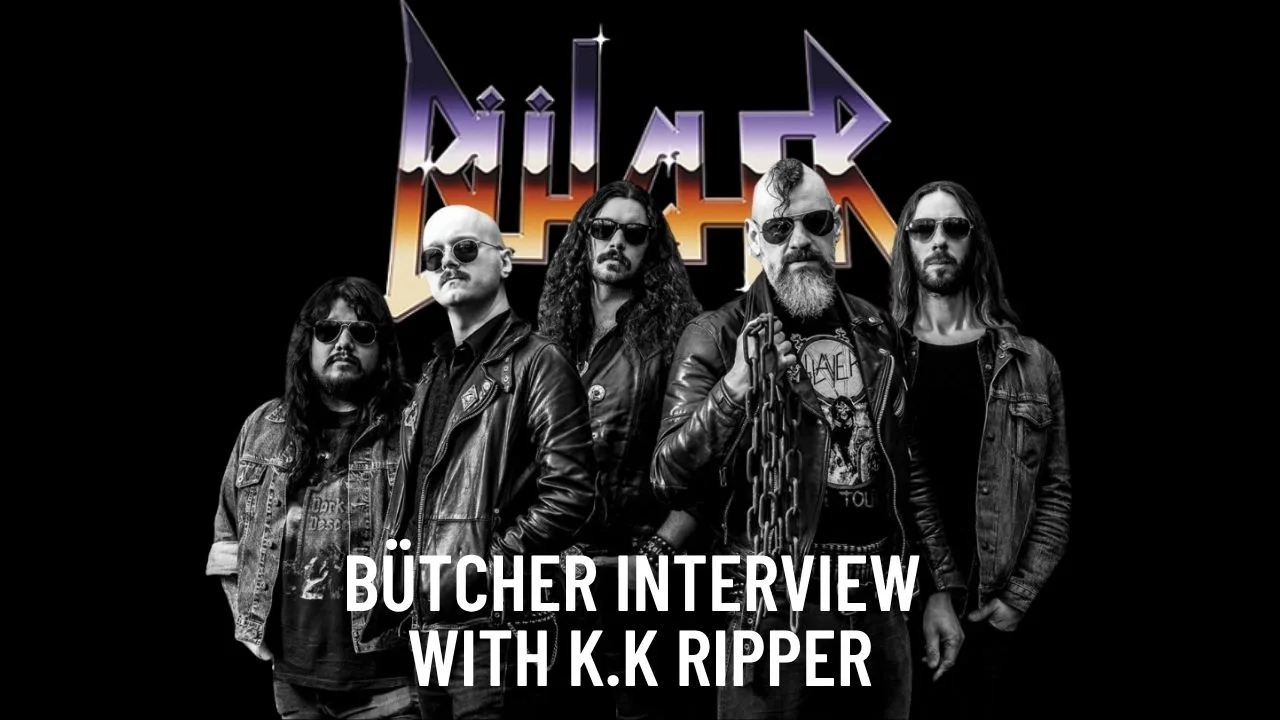

Bütcher is a crushing speed/black metal band, and here is an interview I did with guitar player KK Ripper. Check this band, they crush:
🤘 From 'St. Anger' to the Underground: The Discovery
How did you discover heavy metal and then the whole underground metal scene? Was the music something you got into right away, or did it take a few listens and then you were hooked?
KK: I discovered heavy metal at age 12, like most kids my age, being born in 1990. We came of age in the literal Dark Ages for metal, and since I didn't have any older siblings or family members who were into metal, the first two records that introduced me to heavy guitar-oriented music were 'Iowa' by Slipknot and 'St. Anger' by Metallica. Yes, it was thàt bad. Then, Ruben was already 23 and into all the black/death goodness that persisted throughout those years of heavy metal obscurity. Through being in bands, I developed a musical taste, but I have to say it wasn't until my mid-twenties that I really came into my own as a mature listener. I am, however, fortunate to have had an upbringing in which art, and by extension also music, was really encouraged; because of that, I was exposed early on to a lot of different styles of music, especially through my dad's record collection, which returned to our home when I was 17 after being lent to one of my older cousins. I appropriated all of those records, and they now all reside in my personal collection. So I was aware of Frank Zappa, Tom Waits, Captain Beefheart and the likes, before I ever heard a Megadeth record. I guess with most metalheads my age, it's the other way around. I got heavily into metal in my twenties, and I've always appreciated the possibility to "escape" into metal. It's its own little universe, which is why so many metal songs are about these other fantasy universes like H.P. Lovecraft's Arkham and Robert E. Howard's Hyborian Age. This is the same experience, in my opinion, providing a place to retreat into when the "real" world becomes a bit too overwhelming.
🎸 Technique is a Means to an End: Finding a Unique Voice
Now, at what point in your life did you decide you wanted to join a band? When did you decide you wanted to be a guitar player?
KK: When I was 14, I borrowed a guitar from one of my older cousins, which was a cheap Japanese Stratocaster copy, and a Pignose amp with one knob. I started a band with three friends on the very same day, recording whatever sounds we could get that vaguely resembled a musical idea onto Windows Movie Maker using a headset microphone. Primitive, but I was obsessed ever since. I was sadly the last one of our childhood band to actually get a guitar, so I was quickly assigned to bass. I kept playing the guitar, though, and by age 17, I really wanted to play the guitar rather than bass, so I made the switch, and the guitar became my main reason for living.
Now, how good a guitar player do you think you are, and who are some of your favourite guitar players?
KK: I don't consider myself a particularly great guitar player, specifically technically, nor do I aspire to become one. I find it a lot more interesting to find your own unique voice on whichever instrument you choose and cultivate that. Technique is a means to an end, and not the goal in itself, which is why I'm not very interested in virtuosity. There are, however, a lot of virtuoso players who have an added element of creativity, which makes them very inspirational for me. It might be cliché, but Eddie Van Halen is one of those players; his mind-bending speed is made possible by making use of the ergonomic logic and physical layout of the instrument, foregoing music theory for symmetrical patterns that allow for those breakneck-speed licks. And as someone who likes to understand the logic of other guitar players that I like, it's a lot of fun to clearly see Eddie's influence when I'm analysing something of Trey Azagthoth, for example. I like a lot of blues players, mainly for this unique voice they tend to have on the instrument. Just by the way every blues player uses vibrato to manipulate the notes on the guitar, you can differentiate between them, like it's their own musical signature. Blues is also often looked at with condescension by the fans of virtuoso guitar playing, while it takes a lifetime to understand the dense harmony of it and to navigate within its loose, improvised structure. Albert King is one of my all-time favourites in the genre, and, in a more rock setting, I'm also obsessed with the bluesy playing of Rory Gallagher.
⚡ The Birth of Bütcher: Six Bands to One Focus
Now I know you were in a few bands before, Bütcher, but how did the formation of Bütcher come together, and did you start writing original songs from the start?
KK: I was in a couple of bands, both metal and non-metal, before Bütcher indeed; in fact, when I was asked to join on that faithful night, I was in six bands, making Bütcher number seven. So one rehearsal for each day of the week! Not all bands I was involved with at the time were equally serious, and before long, I had dropped every single band to focus on Bütcher, where the motivation and enthusiasm were at an immediate high. The primaeval incarceration of Bütcher had already written some material, and the first couple of shows we played strictly that stuff plus a cover of Hallow's Eve's "Plunging into Megadeath". However, it didn't take long before I started writing and pitching ideas at rehearsal, and I was eager to start working on material where I could leave my mark on the band as well.
How did you come up with your name and logo for the band?
KK: Well, I wasn't there when it happened, but I imagine it was nothing more complicated than: "Hey, we need a name for this 80s-influenced band we're doing, what bands do we like?", "SLAYER!", and then from there you don't need much imagination anymore 🙂. Concerning the logo, that was made by our first bass player, Jolle, or J.A. Pülsator, and went through a couple of mutations before settling on the current logo we use. It's still basically the same idea and shape, but we use a professionally drawn/painted version of it by Velio Josto, who is probably most known for a lot of the artwork for our brothers in Vulture.
💎 From Debut to Osmose: Finding Their Style
So now your debut release comes out in 2017 on Babylon Cult Records. How do you feel about this release these days, even though different members are on it?
KK: I always look back fondly on those days and, whilst it's never easy to part ways with band members, we are all still in a good personal, friendly relationship. We were adamant about recording in a fully analogue studio, and, even though we had all been in bands before, our combined recording experience was limited. We made some mistakes in the process, which ended up making the finished product sound a bit harsher than we would've liked. We weren't fully developed in our style yet, still finding our own way. So I look at that record like a diamond in the rough, still quite crude and embryonic, but essential in our process.
You come back in a big way as you're now on Osmose for album # 2 called “666 Goats Carry My Chariot”. How did you hook up with Osmose for this release, and I’m to assume you feel this release is a big step up from your debut?
KK: I think with "666 Goats..." we finally really came into our own, even though it was recorded in the face of adversity. We hooked up with Osmose through a promo package of "Bestial Fükkin' Warmachine", which we had sent to all the cool labels we could conceive, and Osmose took the bait! The problem during the recording process was that our first big line-up change happened a week before we were set to go into the studio. Lorenzo Vissol, or L.V. Speedhämmer, of Schizophrenia's fame, was our deus ex machina; learning the songs in less than a week with only one or two rehearsals and then nailing the recording process! What a hero. For us, it was a no-brainer to ask him to join the band full-time, and we had a bunch of great years together. Both musically and technically, we improved immensely with the second record, cementing our position as a growing band and a force to be reckoned with. The sound of the record is to this day still my favourite; it's harmonically rich and warm-sounding, and the lack of click tracks makes for a dynamic, vibrant and natural feel. You can call it sloppy if you want, but I prefer the term "loose", which is basically the same but from a positive perspective.
🦠 COVID: The Loss of Momentum
I read a few reviews of this album, and they loved it. Of course, COVID stuck its head into the world, and I am sure that affected the band very much. How bad did it suck having a fantastic album out, but you couldn’t promote it?
KK: It sucked massively! I remember distinctly being in Hamburg, playing the Hell Over Hamburg festival in 2020, when we were still laughing about this apparent virus in China that everyone was freaking out about. I generally live under a rock and don't really follow the mainstream media, and this was no exception. A week later, we were in prison. In hindsight, I could have used the time that was given to me so much better. Luckily, "666 Goats..." proved to be a strong enough release to survive this, but I can't stress enough the amount of sucking that we couldn't go out there and bring the Metal to the masses!
✍️ Songwriting Philosophy: Inspiration and Controlled Chaos
When do you think you started to find the “Bütcher” sound, so to speak? How easy is it for you to write songs?
KK: With "666 Goats..." I really honed my craft as a songwriter. I created all the riffs, arranged the songs and played basically all the instruments in the studio except for drums and vocals. I did develop some serious control issues with regard to the creative process, which continued during the recording process of "On Fowl of Tyrant Wing". Right now, it's paramount for me to make the composing as much of a team effort as possible, which requires me to learn to let go of some of the control. It's quite easy for me to write IF I'm inspired! If there's no input, you can't have output; for me, that's very important. I have a very open mind and allow myself to be inspired by anything. Generally, if I find a cool musical concept to spark the fire, I go into hyperfocus and flesh it out using my own musical logic, which is, of course, full of my own idiosyncrasies. I tend to cultivate these idiosyncrasies so that the music I make can be very diverse but will always sound like Bütcher.
🏰 On Fowl Of Tyrant Wings: A King Diamond-Inspired Trilogy
So, now, when did you start to begin work on your godly new release called “On Fowl Of Tyrant Wings” also on Osmose? How easy was it to come up with songs for it?
KK: Like I mentioned above, for writing, I need to be inspired. During the COVID-19 crisis, I was not inspired. I was unable to go to shows myself, so I didn't feel the spark during this period, which is unfortunate since we did have the other essential part of writing: time. Time I sadly did not spend as wisely as I should have, in hindsight. I did, however, rediscover my love of old school heavy metal; this did seep into the songwriting eventually. This is the most old-fashioned heavy metal-inspired music we've released to date. When the lockdown ended and we started playing shows again, we were soon faced with the devastating news that Lorenzo would have to quit because of the conflicts in schedule with Schizophrenia. He was, however, willing to write a new record with us before leaving, so I took it upon myself to write and rehearse a record in six months, arranging the songs with Lorenzo's input. The fact that there was a deadline kick-started the creative process, and I lost myself quickly in the writing. For me, this was not the most satisfying process, and by the time everything was recorded, I was left feeling a bit burnt out, which is why we are now adamant about making composing a team effort.
Now this is a concept album of sorts, with 3 long songs on Side B. Whose idea was that, and I think they stand tall right alongside the speed/black metal tracks on this release?
KK: The seed for this idea was planted during the recording process of "666 Goats..." already; the idea came from being total nerds about King Diamond/Mercyful Fate and the want to write something with the same conceptual scope. We (me, Ruben and Lorenzo, sitting at the hotel bar) already came up with the essential elements of the storyline then and there: the medieval setting, the nobleman being seduced by the gypsy woman who turns out to be a witch and an agent of Satan... I had started writing on and off on this project throughout the years, starting in 2019, collecting riffs here and there. When Lorenzo dropped the news on us, I started arranging these songs like a madman. The one productive thing I did during COVID was install myself to record riffs on my pc at home with programmed drums, so I could make primitive pre-production for myself and the others of these songs and these ideas. Without this, I never could've written something with this kind of scope in such a short time. I also included a lot of riffs I had first set aside for a hypothetical traditional heavy metal side project, which is why the amount of blackened material is much lower on this release than on the previous records. Ruben then later wrote the whole story, inspired in part by the writings of Clark Ashton Smith of the fictional medieval French province of Averoigne. The whole 'witchfinder'-vibe adds so much gravitas to the trilogy, I feel it's a perfect fit for the more dramatic, heavy metal-inspired composition.
🚫 The 'Tribute Act' Label and Future Covers
What would you say to someone who thinks you're a tribute act? I don’t, for the record.
KK: To go fuck themselves. If you choose to self-apply a term like 'tribute act' (if you're not actually a 'tribute band', which is different) or 'retro band', you are merely cosplaying as a metalhead instead of just being one. I listen to the music I listen to, and it logically inspires my own output. I wear my influences on my sleeve, and while I do add parts as a tribute to the greats of old, calling my music a 'tribute' means you're not initiated enough to hear what we are trying to do.
If you were to do 3 cover tunes, what songs and why those 3 tunes?
KK: Ah, this is a fun one. We did a lot of live covers in our career already, from bands like Hallow's Eve, Manowar, Metallica,... I'm going to pick three hypothetical covers that I personally think would be interesting to do!
- Rush - Bastille Day: A proto-speed metal song from one of my favourite Rush records, "Caress of Steel." I can imagine Ruben screaming: "The guillotine will claim its bloody price," in his trademark falsetto.
- Metallica - Trapped Under Ice: One on my shortlist. I've always liked doing old Metallica covers, because they still have the brawny headfirst intent which they sadly lost later in their career. Plus, everyone knows them; it's like an entry exam to know these if you want to get into metal.
- Manilla Road - Haunted Palace: I'm a huge Manilla Road fan; the way Mark Shelton composes riffs on the guitar consistently informs how I approach the instrument. I also really like the drumming on this particular song, by Randy 'Thrasher' Foxe. I was luckily able to have a short conversation with 'the Shark' two days before his death. An absolute gentleman towards his fans and an unbridled creative force!
🌍 Spreading the Gospel: Prioritising New Territory
CF: Do you hope to get to play a good amount of live shows supporting this record?
KK: We did a short run of cool shows at the end of 2024, which included two release shows that we helped organise together with booking agencies Loud Noise and Heavy Duty Booking. I'm still very proud of the record, and we have some cool shows coming up in 2025, when I'm writing this. Finland, Greece, Spain, Portugal, some other cool stuff further in the future that still needs to be announced... But our main focus now is to start writing with the new line-up. My brain works like this, you know. The record is finished, so on to the next! We all have our day jobs with limited days off from work, so we are getting rather picky on which shows we accept. I tend to think it's more important to spread the Gospel of the 666 Goats in places we haven't been before, for fans who are unlikely to see us perform often, and we prioritise that over doing consistently bigger and bigger shows.
How would you describe the band to someone who has not heard your music?
KK: SPEED METAL! I love this term, just because it's so vague. It's less strictly defined like thrash/death/black... The umbrella term 'speed metal' denotes a feeling more than a genre, which is constantly present in the music of Bütcher, whilst the music itself can be quite diverse. If you understand this, you'll likely understand what Bütcher is doing regardless of whether you're listening to one of our older, more blackened offerings or a part of the most recent epic trilogy.
I think it is fantastic myself that a band like yours can write some classic, speedy and catchy as fuck metal with tunes that as easy to get into and are memorable too. You get a double horn up from me for that.
KK: Thank you so much, man, that means the world to us. What I can say about that is that I'm (as an amateur) very interested in the "science of song writing", you know? Analysing other songs and finding out what makes them tick, what makes them work. And this can inform my own songwriting, even across different genres. Sometimes I'll hear a cool compositional device that's used in a pop song and force myself to use it in my own writing. This makes for more inspired and exciting songs, in general!
Please plug any social media sites the band has, and where can people pick up this fantastic new release?
KK: You can just check us out on Instagram and Facebook https://www.instagram.com/butcherspeedmetal/ https://www.facebook.com/Butcherspeedmetal. People can order the record through the webshop of Osmose Productions, or catch one when you catch us live!
KK, horns up for the music and doing this interview. Any last words? The floor is yours?
KK: Thanks to everyone who took the time to read my ramblings! Other than that, if you're still reading metal magazines on which every format, you are most likely fighting the good fight and I'm probably preaching to the choir, but to you I say: NEVER FÜKKIN' WEAKEN, BRETHREN AND SISTREN OF STEELE!
Chris Forbes
WriterChris Forbes has been covering the underground metal scene since the late 80s and runs the Metal Reviews column at Extreminal.
Related Articles
Cryptosis Interview With Frank te Riet
Words of Farewell Interview (Video)
Blood Feast Interview With CJ Scioscia
Comments
No comments yet.